
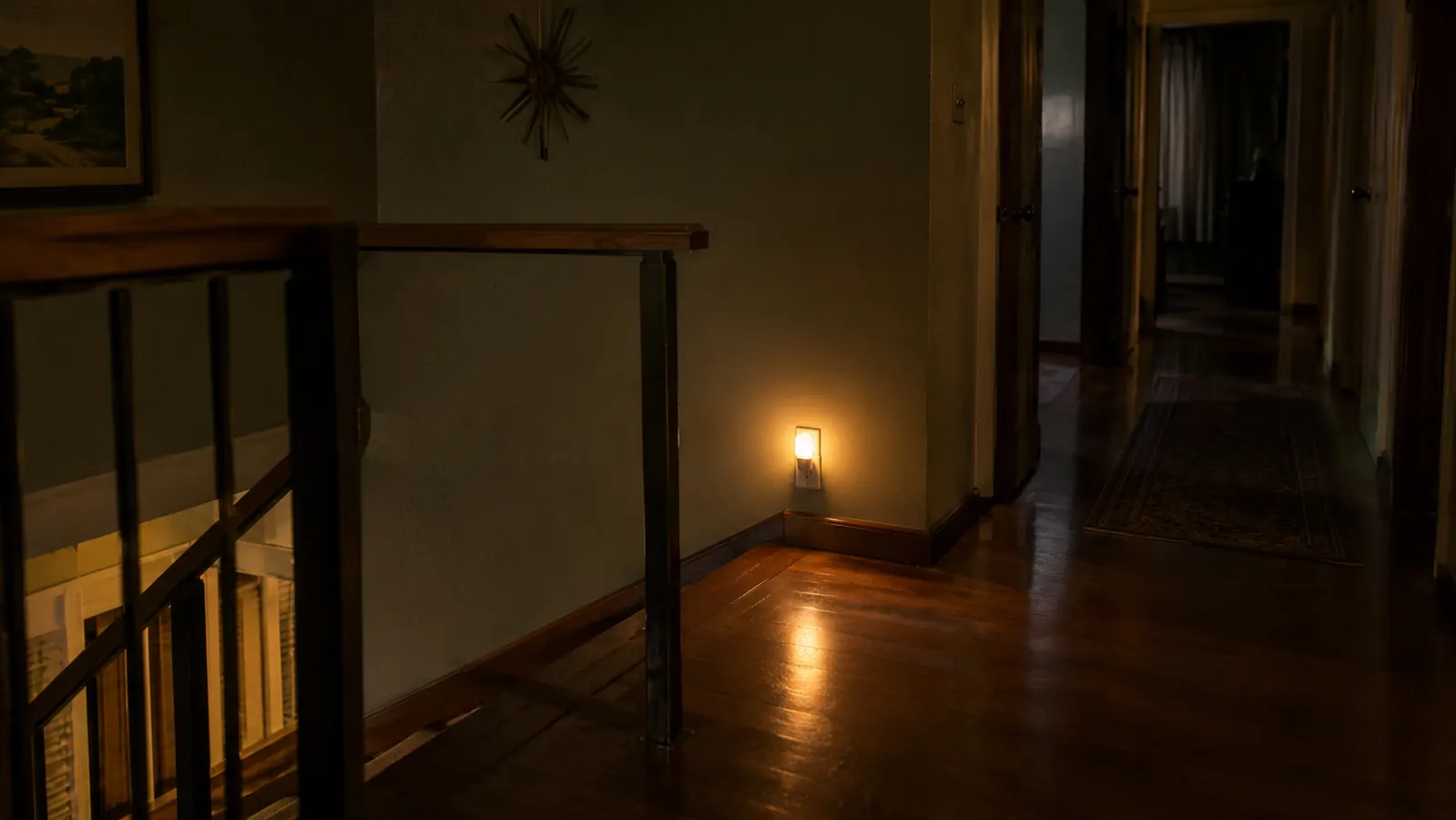
Forgive me for starting with the boring part, but someone has to: a night light is only as good as the outlet it lives in. I learned that last winter, which is also when I learned what the AUVON plug-in night light does well and where it simply won't help you. This is the honest version, the one I would give a friend over coffee, not the one with the pretty pictures. Eight months in, here's what I actually think, including the parts the product photos leave out.
Kate, my daughter, brought over the AUVON four pack after she got tired of hearing me insist I could find the half bath in the dark. She lives about an hour away and comes up most weekends, and somewhere around the third visit she stopped asking and just ordered them. I could find the bath most nights. The problem was the one night I couldn't, and the memory of the bathtub slip that bruised my hip two winters ago was enough to make me plug every light in the same evening. That's the whole review in a sentence: these lights made me stop doing a thing I knew was risky, and they made it easy. Everything else is detail, and a few of those details are things nobody mentions in the listing.
The Quick Verdict
Four dependable, unglamorous workhorses for the stairs, the hall, and the bathroom path. Not a bedside light and not a fall-prevention tool, but excellent at exactly the job they're built for: seeing where your feet are going at 2am.
Amazon Check Today's Price →The night path, handled in one evening
One AUVON four pack covered my two short stair runs, the upstairs hall, and the half bath. No wiring and no electrician, just plug them in and let the sensors do the thinking. Check today's price on Amazon.
Amazon Check Today's Price on Amazon →How I've Used Them
Here's the layout. My house is a 1962 split-level, which means short stair runs between every level and no stretch of hallway long enough to get properly lost in. The full bathroom is upstairs, the half bath is downstairs, and the kitchen sits at the middle level, so any night trip crosses at least one stair edge and one dark threshold. I put two AUVON lights at the top and bottom of the main stairs, one in the upstairs hall, and one in the half bath. All four were in place within an hour of Kate leaving, which was the fastest I have ever acted on a safety idea in my life.
The motion sensor is what sold me. In the half bath, the light comes on as I reach the doorway and stays on long enough for me to do what I came to do and find my way back to bed. In the upstairs hall it catches me coming from either the bedroom or the top of the stairs. I never touch a switch, and the light turns itself off a little while after I leave. The dusk to dawn sensor means it spends the daylight hours fully dark, so it isn't burning in an empty room.
What Nobody Tells You About Motion Sensors
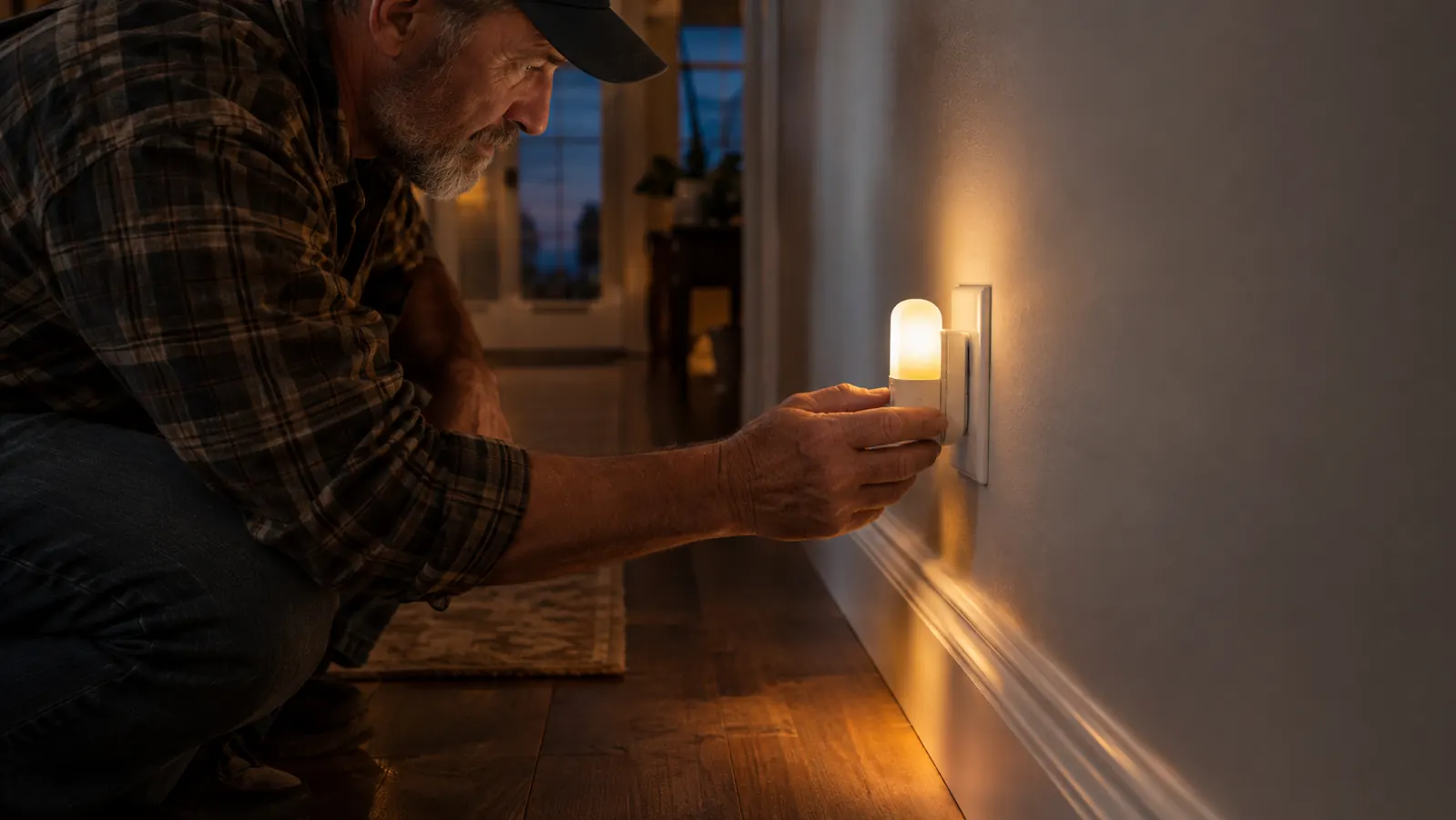
The first week, I put the half bath light on the wall right next to the door frame. It looked tidy. It was also useless, because the motion sensor pointed at the door and could not see me until I was already inside, at which point the light snapped on and lit a room I was already standing in. I moved it to the wall across from the door, and now it catches me in the threshold exactly where I need to see the floor. That one move turned a so-so light into the best one in the house.
Here's the honest part nobody puts in the photos: the sensor has a range and a direction. If the light is on a shelf, the sensor may read the ceiling. If it's behind a towel or a robe, it reads nothing. Plug one in, walk toward it from every direction your feet actually travel, and adjust until it sees you coming. Ten minutes of fiddling at install saves you a year of muttering at 2am.
First, the delay is real and it's mostly your friend. The AUVON waits just long enough to be sure before it switches on, so it doesn't flicker at you every time a curtain moves or a heating vent kicks on. But that same politeness means it will not light a step at the exact instant your foot is over it. In practice, by the time I reach the top of the stairs the light at the bottom is already on, because it saw me coming down the hall. Just don't expect it to catch a mid-stumble. It can't, and no plug-in light can. That one second of patience is the difference between a light you trust and a light that cries wolf, and this one earns my trust.
Second, it's brighter than you expect from a night light, and that's good in a hall and annoying in a bathroom. At 2am, the half bath goes from black to bright the moment I cross the threshold. Some nights I love it, and some nights I wish it whispered instead of announced. If you're the sort of person who resents the sun coming up, put it outside the bathroom door instead of inside, or accept the brightness as the price of actually seeing the floor.
Third, it can only see so far. In my upstairs hall the range covers the full run, but in a longer hallway you may want one at each end. My rule of thumb: if you can't see the light from the spot where you first need it, it's too far away. Move it closer before you blame the sensor.
The Dusk to Dawn Setting Is the Quiet Half
The motion sensor gets the attention, but the dusk to dawn sensor is the half that makes these worth owning. During the day the light stays off completely, even if something brushes past. At dusk it shifts into waiting mode, so the moment I walk into its view, I get light. I like this for a selfish reason: I come home at different hours, and I never wanted to stand in a dark foyer with an armful of groceries trying to remember which switch is which. The first evening I walked in at dusk and the stair light was already awake before my foot hit the landing, I laughed out loud at how easy it all was.
It also means the lights earn their keep without wasting power. Four of them have been plugged in for eight months and my electric bill hasn't moved in a way I can point at. I don't track my bill down to the dollar, but I would notice a jump, and there hasn't been one. These are the kind of small loads that disappear into the noise of the fridge and the water heater. Power bills are a boring subject, I know. But when a thing stays plugged in all year, the cost question is the one people actually ask me, so it deserves an honest answer.
The honest caveat: dusk to dawn means on all night, every night, whether you're up or not. The light sits there glowing in the hall from dusk until dawn, ready. That's the trade for never fumbling for a switch, and for me it's the right trade. But if you sleep with your door open and the hall light bothers you, this may not be the light for the spot outside your bedroom.
The Four Pack Forces You to Map Your House
A four pack sounds like more light than you need until you walk your own house at night. For me it was exactly right: top of the stairs, bottom of the stairs, upstairs hall, half bath. That leaves the kitchen dark, and it turns out the kitchen is fine. I don't need to see the kitchen at 3am. The four pack forced me to decide which paths I actually walk in the dark, and that decision was worth more than any individual bulb. My mother would have liked these, once I convinced her they weren't just for people who are 'getting older.' They aren't. They're just good design doing its job without a fuss.
My advice: do the map before you plug anything in. Get up tonight the way you actually get up, and write down every stair edge and threshold you cross between the bed and the bathroom. Then count the outlets along that route. You'll be surprised how few you need. If the answer is three, buy the four pack anyway, because the fourth becomes the guest bath or the basement stair, and someday you'll be glad it's already there. That is the quiet magic of the four pack: it makes you think about your house as a path, not a problem.
The only room I'd skip is the bedroom. A light that wakes when you roll over is a nuisance, and this one is too bright for sleeping. These belong in the paths, not at the pillow. If you want a hands-free light in the bedroom itself, look for something dimmer and warmer than a plug-in motion light.
The GE motion night light gets good reviews, and a neighbor of mine uses one. I can't offer an honest side-by-side because I've only lived with the AUVON, so I'll keep this simple. I chose the four pack because the math worked for my house: four lights for the four spots I actually needed, and the dusk to dawn setting on each one. The GE is a fine product. I just didn't see a reason to favor one brand's name over the other on a thing this simple.
I also considered just leaving the hall light on overnight. That's what my mother did, and it works, in the way a hammer works on a screw. It's bright, it blazes all night, and it costs more than it needs to. What I wanted was a light that was there when I needed it and gone when I didn't. That's the whole job description, and it's surprisingly rare.
The Falls Conversation I Almost Didn't Have
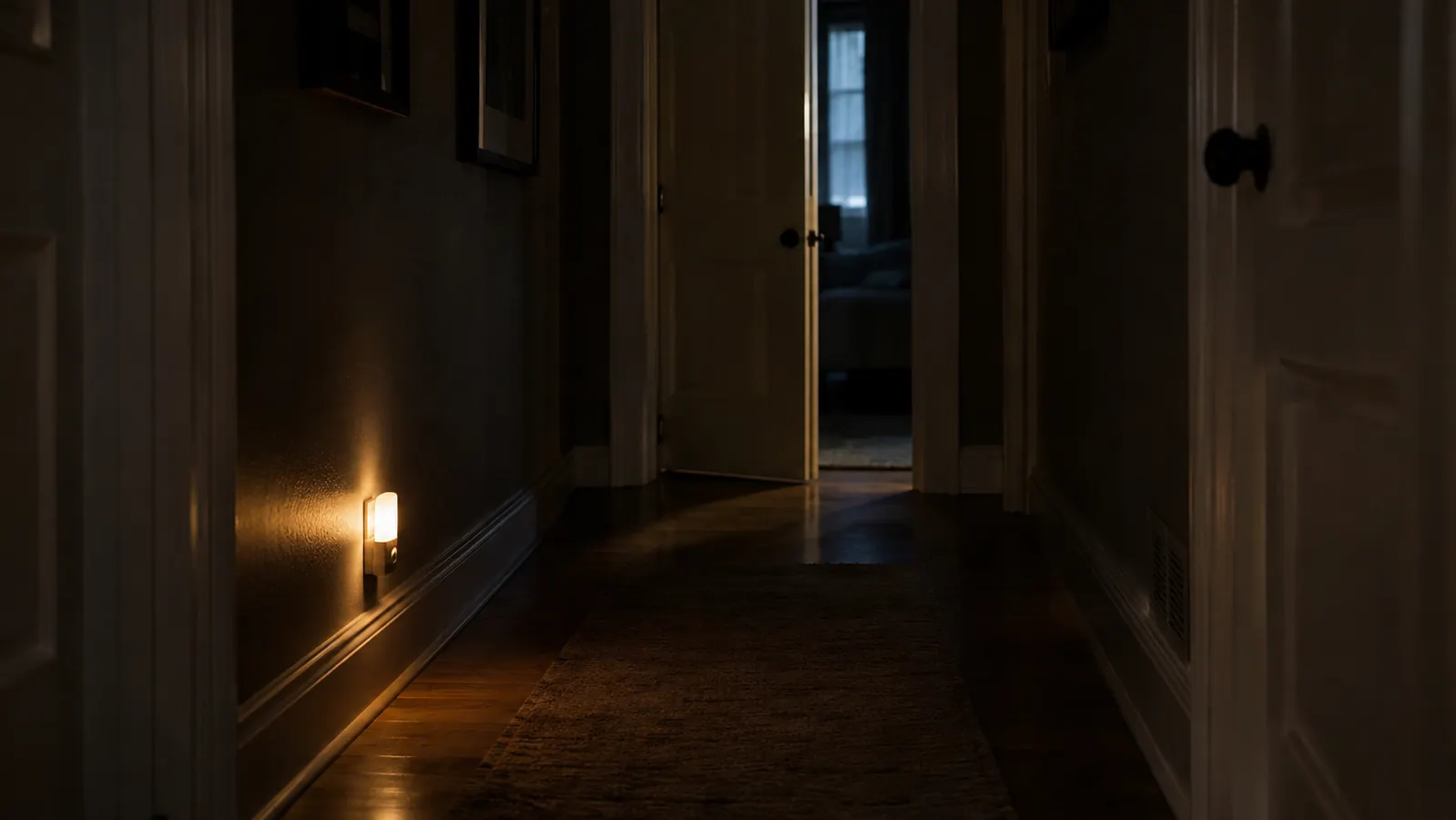
Here's what nobody puts on the box: the real reason people buy these isn't the light, it's the fear. My slip two winters ago wasn't a bad one. I caught myself on the sink, bruised my hip, and spent a week being sore and a month being embarrassed. But it changed how I walked to the bathroom for months afterward. I held the wall. I turned on every light in the house. I did the things that made me feel old. That month taught me something useful: the fear after a fall is its own injury, and it heals slower than the bruise. These lights are the first thing that made me feel the opposite.
And I want to be plain about the limit. A night light helps you see the path. It does not catch you if you fall, and it does not fix balance. If you are holding the walls at night, or if you've had a real fall or a near miss, please talk to your doctor or a physical therapist. If they suggest a grab bar in the tub or shower, get one that is screwed into the studs, not one that sticks on with suction. A suction bar is for steadying, never for catching your full weight. I say this the same way I'd say it to Kate, because I care about you like I care about her. See the floor first. Then get whatever your legs actually need.
What I Liked
- Motion sensor means light only when you need it, not all night in an empty room
- Dusk to dawn setting keeps the lights dark during the day and ready at night
- Four pack covers the stairs, the hall, and the bathroom path in one box
- Eight months in, all four still work without a single hiccup
- No wiring and no tools, I installed all four in one evening
Where It Falls Short
- Blocks the second outlet on a duplex, which I didn't notice for a week
- Brighter than I expected, too bright for a bedroom or a sleepy 2am bathroom trip
- Sensor has a range and a direction; behind a door or a towel it's useless
- Dusk to dawn means on all night, every night, no exceptions
Eight months, four lights, zero missed steps, and a hallway I no longer think about at 2am. That's the whole case for these.
Who This Is For
These are for the person who gets up at night, full stop. If that's you, and your route to the bathroom crosses a stair edge or a rug or a shadow, buy the four pack and do the map. They're also for the person who is tired of being told to just be more careful. Careful is not a plan. A lit path is a plan. If you've been meaning to do something about the dark hallway and you keep not doing it, this is the easiest version of that decision I found.
Who Should Skip It
Skip them if your trouble is balance and not darkness. If you're unsteady on your feet, if you've fallen, if a doctor has told you to use a walker or a cane, a night light is not the fix and I'd be dishonest to pretend it is. Start with the doctor or the physical therapist, then look at the anchored grab bars and the handrails and the things that actually bear weight. Come back to the lights once the real help is in place. They make a good house better. They cannot make a dangerous one safe.
Do the midnight walk, then decide
If your route to the bathroom crosses a stair edge or a shadow, that's the four pack calling. AUVON's set covers the whole path in one box. Check today's price on Amazon.
Amazon Check Today's Price on Amazon →