
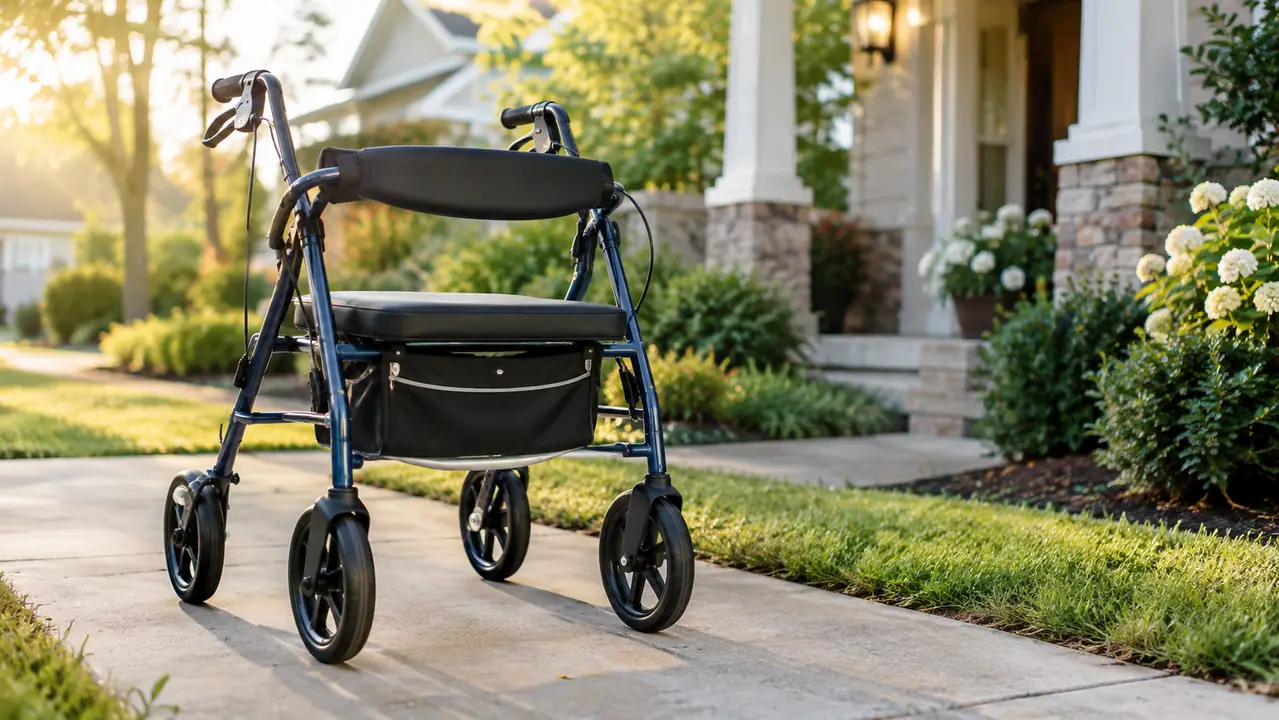
The morning after my hip landed on the edge of the tub, I sat on the bathroom floor and took inventory of my house. I was 65, I lived alone, and the split-level outside Hartford suddenly felt like a place that wanted to hurt me. My daughter Kate found me the Drive Medical rollator two weeks later, and I will be honest: I did not want it at first. It looked like something my mother would have used, and my mother used a walker toward the end of her life, and I was not ready to be that person yet.
Five months in, I have changed my mind. I use it every single day, not because I have to, but because it makes the day easier. This is my long-term review of the Drive Medical rollator for aging in place, written from the far side of the everyday use that the product photos never show you.
The Quick Verdict
A dependable everyday rollator that does exactly what it promises: steady support, a place to sit, and a frame that survived five months of daily use without a single loose screw.
Amazon Check Today's Price →The Rollator I Reach For Every Morning
If you are weighing whether a rollator is worth it, this is the one that convinced me. It folds flat enough for my Forester, rolls smoothly over the sidewalk joints on my morning loop, and the seat has rescued me on more than one long walk.
Amazon Check Today's Price on Amazon →How I've Used It
A rollator is not a walker, and the difference matters more than I expected. My mother used a pick-up walker in her last years, the kind you lift and set down with every step. A rollator rolls, so you push it along and keep a natural stride, and you are not stopping to heave the whole frame forward each time. I take mine on a one-mile morning loop to the end of my street and back, and my posture is straighter now than it was when I walked free-handed and braced against the wall.
I use it inside the house too. The split-level has short stair runs between the levels, and on the days my hip complains, the rollator gives me a steady thing to hold on the landing. I keep it parked by the kitchen island when I cook, because standing at the counter for twenty minutes used to leave me grabbing for the edge with one hand while I stirred with the other. Now I lean on the handles, and the seat is right there the minute I need to sit.
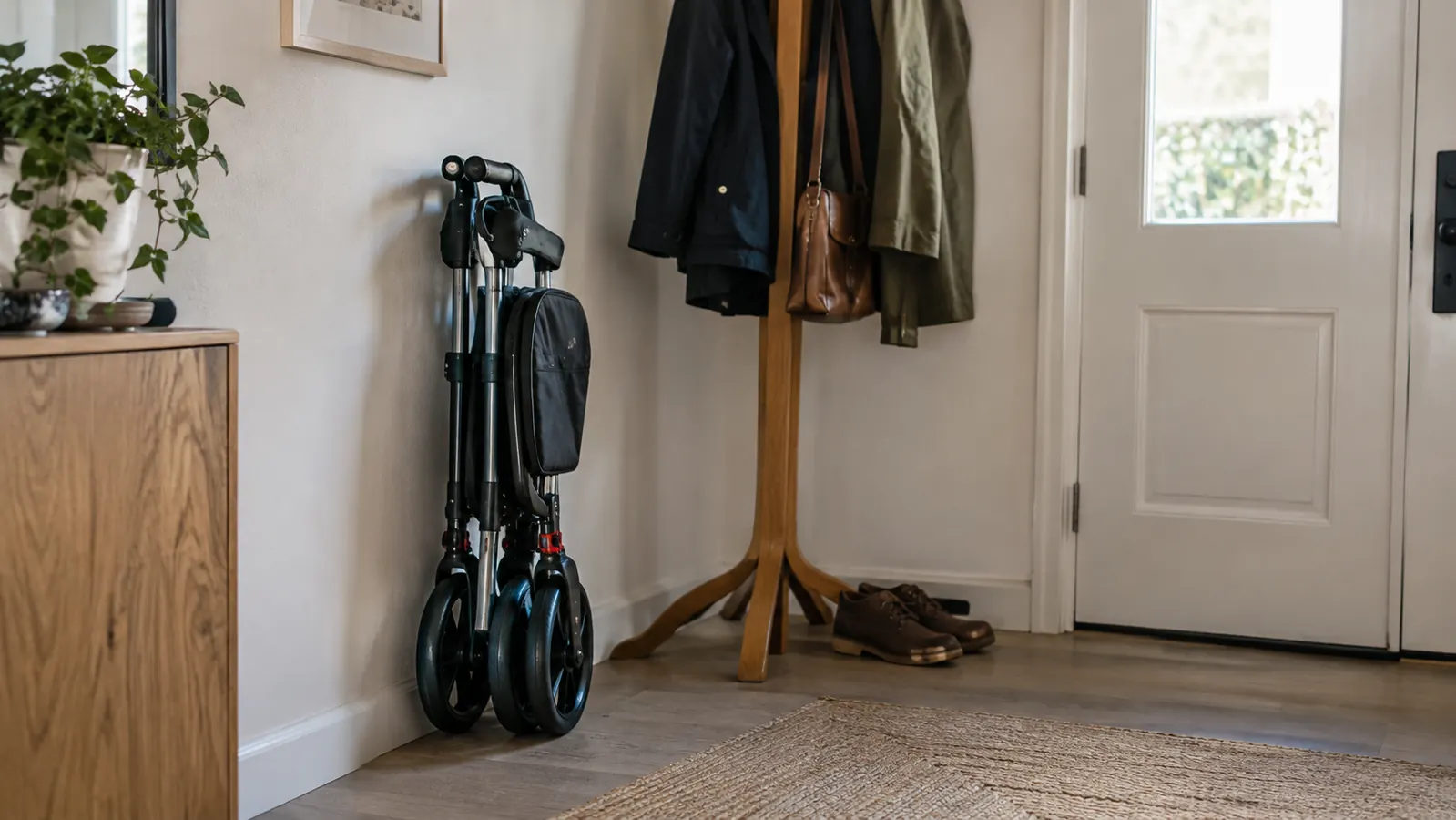
I have loaded it into the car at least twice a week for five months. It folds with one motion, I lift it into the back of my 2015 Subaru Forester, and it has never once fought me. That sounds like a small thing. Anyone who lives alone will tell you it is not a small thing.
The seat has also saved me in waiting rooms. At the dentist's office, where the chairs are low and hard to get out of, I bring the rollator in and sit on its seat at the height that works for my hip. That sounds like a small thing until you are the one stuck in a low chair, trying to stand up with everyone watching.
The 7.5-Inch Wheels Make the Difference
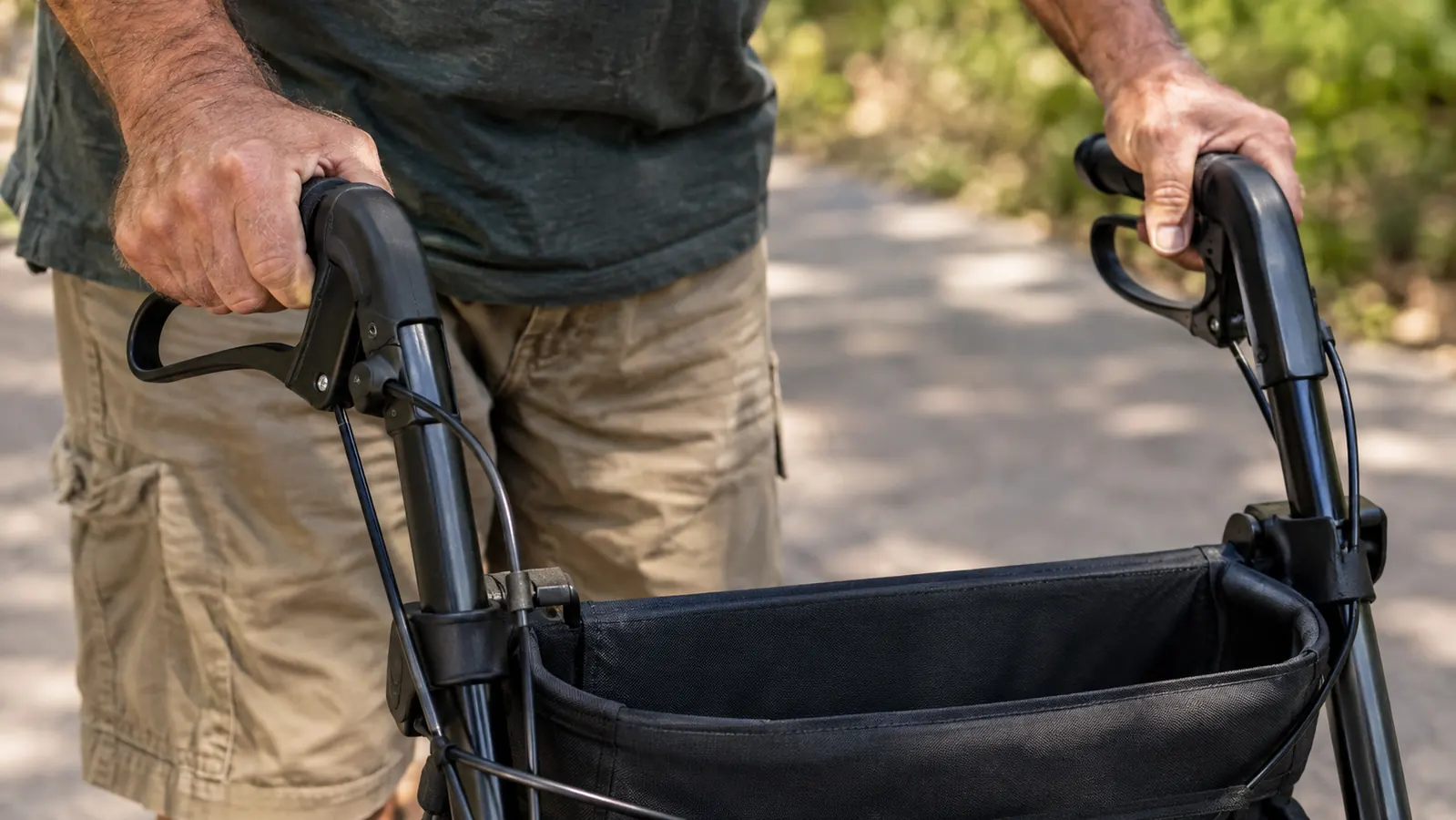
The first thing I learned while comparing rollators is that wheel size decides where the walker can go. Bigger wheels roll over bumps; smaller wheels catch on them. The Drive Medical comes with 7.5-inch wheels, which sits right in the middle, and the middle is exactly where my life happens. They roll over the curb cut at the end of my street, the gravel edge of the senior center parking lot, and the ridge where my front walk meets the porch step without ever stopping me.
Inside, the 7.5-inch wheels behave well on every floor I have in the house: hardwood, low-pile carpet, and the vinyl in the kitchen. On the carpet they roll a touch slower, and I actually like that, because it keeps the rollator from skating ahead of me when I turn. On the hardwood they glide. I never feel like I have to wrestle it, and I never feel like it is about to get away from me.
The brakes are the detail I would have overlooked if I had bought blind, and they are the reason I trust the seat. They are loop locks: you squeeze the handles to slow down, and you push down to lock them in place. I lock the brake every single time I sit, without thinking about it, and the rollator has never once rolled out from under me.
The seat itself is padded and wide enough that I can sit comfortably for a few minutes, and the backrest means I can lean back instead of hovering at the edge. I use it as a rest stop on long walks: two or three minutes, catch my breath, then push on. It is not an armchair, I will say that plainly. It is a place to pause, and a place to pause is exactly what I needed.
How It Held Up Over Five Months of Daily Use
Last week I gave the rollator the same once-over I give the smoke detector batteries. Every folding joint still clicks shut firmly. The brakes still hold on the first squeeze. The wheels spin true and none of the bearings grind. The storage pouch under the seat has carried my keys, my grocery list, my phone, and a paperback, and the zipper still runs smooth. I assembled it out of the box in about ten minutes with the two little tools that came with it, and I have not tightened a single screw since the day it arrived.
The wear I can see is honest wear. The front wheels have picked up a few scuffs from curbs. The seat shows a faint line where I have sat on it day after day. Nothing wobbles, nothing squeaks, and nothing has needed replacing. For a piece of equipment I use every morning and most afternoons, that is the outcome I wanted when I bought it.
A word on how I treat it, because I think it matters. I fold it before it goes in the car so it is not bouncing around loose. I wipe the handles down when they are dirty. I check the brakes before I sit, every time, and I do not hang my full weight on it when I lean. Take care of a rollator and it will take care of you. That has been my experience.
The folding joint was the part I worried about most, since I fold and unfold this rollator so often. It still opens and locks with a firm click, and it has never once collapsed on me mid-fold. I have also left it folded in the car on hot afternoons, and the frame has not warped or complained.
The Tradeoffs Nobody Mentions in the Product Photos
For all that I like it, the Drive Medical rollator has compromises, and you should hear them before you buy. First, it is not small. It is lighter than it looks, but folded, it still claims a corner of my entryway, and on a rainy morning I have to move it to get the coat closet open. If you live in a small apartment, measure your hallway before you commit.
Second, the seat is for resting, not for living in. I see people at church and at the senior center use rollator seats like waiting-room chairs during long events, and this one will not pamper you. Three quiet minutes on the seat is lovely. Forty minutes is a different story, and then my hip wants me up and walking. That is what the walker is for, and I would rather it be honest about that than promise me a lounge chair.
Third, and this is the point I want to make loudest: a rollator is not a grab bar. It keeps you steady while you roll, but it is not something you hang your full body weight on, and it is absolutely not the tool for the bathroom. My bathtub scare two winters ago is why I had a proper grab bar screwed into the studs beside the tub, and I still use that grab bar every single day. If you are unsteady in the bath, or if you have already had a fall, or if you are recovering from surgery, talk to your doctor or a physical or occupational therapist before you buy anything at all. A rollator is one tool in a safe-home kit, not the whole kit.
The Alternatives I Looked At Before I Bought
I did not buy the first rollator I saw. I spent an afternoon at the medical supply store with my daughter Kate, testing three of them side by side, and that hour was worth every minute. The lightest one lifted easily into the car, but its wheels were smaller and I felt every crack in the sidewalk on the test roll out front. The heaviest one rolled beautifully over the rough patch by the loading dock, but I could not get it into my Forester without Kate's help, and on a Tuesday afternoon she is an hour away.
The Drive Medical sat in the middle of those two, and the middle is where my life happens. It is light enough for me to manage alone, light enough that I do not dread the car trip, and it has wheels I trust on the sidewalk. Now that I have lived with it for five months, I would make the same choice again. I tell you this because the best rollator is not the one with the best photo or the most reviews. The best rollator is the one you will actually use, every day, without resentment, and I use this one daily.
One more note on choosing. There are rollators with padded backrests, bigger frames, and higher price tags, and they are fine products. I looked at them online, the way you are looking at this one right now, and I kept coming back to the same three questions: Can I lift it myself? Will it fit in my car? Will I be comfortable pushing it into the senior center? This one answers yes, yes, and yes, and after five months, those three yeses have mattered more than any feature list.
What I Liked
- 7.5-inch wheels roll smoothly over sidewalk joints and curb cuts
- Folds flat in one motion and fits in my Forester without a fight
- Padded seat with a backrest forgives a long morning on my feet
- Loop brakes lock firmly; I have never felt the rollator slip
- Easy assembly, about ten minutes, and no maintenance since
Where It Falls Short
- Folded, it still claims a corner of the entryway
- The seat is a rest stop, not an armchair
- Not a trail walker; keep it on pavement and smooth paths
- You have to be honest about your own needs before you buy
Five months of daily use, and I have not tightened a single screw since the day it arrived.
Who This Is For
Buy the Drive Medical rollator if you want to keep moving through your own house and neighborhood, the way I do. It is for the person who walks the morning loop, stands at the counter too long, and needs two quiet minutes on a seat before the next lap of the day. It is for the person who lives alone, the way I do, and needs gear they can lift and fold themselves. I was that person in March. I still am.
Who Should Skip It
Skip the Drive Medical rollator if you need to sit for long stretches, because the seat is built for rest stops, not for long waits, and your hip will tell you so at minute fifteen. Skip it if most of your walking is on rough ground, because a 7.5-inch wheel is a sidewalk companion, not a trail tool. And if you are unsteady enough that you worry about catching yourself, or you have recently fallen, or your doctor has told you to use a walker or start physical therapy, do not let a rollator replace that advice. Talk to your doctor or a physical therapist first. I did my own safety work around my house after my fall, and the rollator is one tool in that kit, not the whole kit.
The Rollator That Won Me Over in Five Months
I did not want this walker in my house in March. In August, I do not want to do my mornings without it. If it sounds like it fits your life, check the current price on Amazon and read the recent reviews. The people who have owned one for a year are the ones to trust.
Amazon Check Today's Price on Amazon →