
The winter after I slipped getting out of the tub, I stayed inside more than I like to admit. I blamed the weather, then the damp, then the shorter days. The real problem was the fear. By March I realized the walk to the mailbox had become the longest trip of my day, and I missed the river path something fierce. The fear was real, and it was not doing me any good.
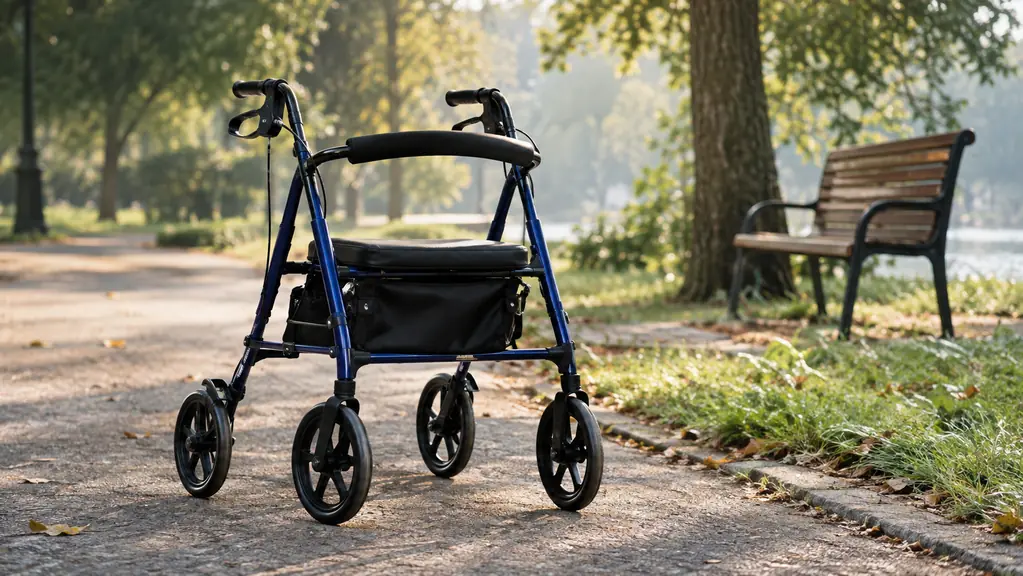
The thing that turned it around was a walker with wheels and a seat: the Drive Medical rollator. I have used mine for over a year now, and I can tell you the seat is the whole trick outdoors. Knowing you can stop and sit anywhere changes the shape of a walk. You do not have to be tough. You just need a place to land, and this thing carries one with you.
A rollator with a seat is the difference between 'I will try' and 'I am going'
The Drive Medical Rollator Walker with Seat has 7.5-inch wheels that roll over sidewalk cracks and packed paths, a seat that locks solid when you need to rest, and a basket under the seat for your water bottle and phone. It has been my companion on morning walks for more than a year, and it made the difference for me.
Amazon Check Today's Price on Amazon →Why the Seat Changes Everything
Here is what nobody tells you about walking when you are 67 and you have taken a fall. The hard part is not the walking. The hard part is the what-if: what if I get tired halfway, what if there is nowhere to sit, what if I have to call my daughter to come get me. Those thoughts weigh more than any distance.
A rollator with a seat takes the what-if off the table. The seat is with you at every step, locked and ready. You do not have to find a bench; you bring your own. That single fact changed walking from something I braced myself for into something I looked forward to.
I will say the obvious thing as well. The Drive Medical rollator has been dependable for me. The brakes still hold, the wheels still roll true, and the seat still locks the way it did on day one. But the bigger change was in my head. The gear is half of it; the confidence is the other half, and they feed each other.
Step 1: Pick a Route With Places to Sit Before You Need Them
The first thing I did was stop thinking of a walk as a straight line out and back. I started thinking about where I could sit along the way. My river path has benches at even intervals, and I know exactly where every one of them sits: the one by the big willow, the one at the boathouse turn, the two near the parking lot at the far end. I planned my walks around those benches before I planned them around distance. Distance is just the part you brag about later. Sitting is the part that gets you out the door.
You do not actually need benches, because the seat of the rollator is right there with you. But a route with known resting spots gives you confidence on the days you need it. I scouted mine first with the rollator in the car. I walked the loop once, noted the curbs and the slopes, and then chose the version of the route I would actually enjoy taking.
If your neighborhood has no benches at all, that is fine. A library with a lobby, a pharmacy, a church hall, even a bank with a chair by the door. Those become your rest stops. You are allowed to build a route around places to sit. That is not cheating; that is planning, and planning is what keeps you going.
Step 2: Set the Height and Test the Brakes Before You Leave the House
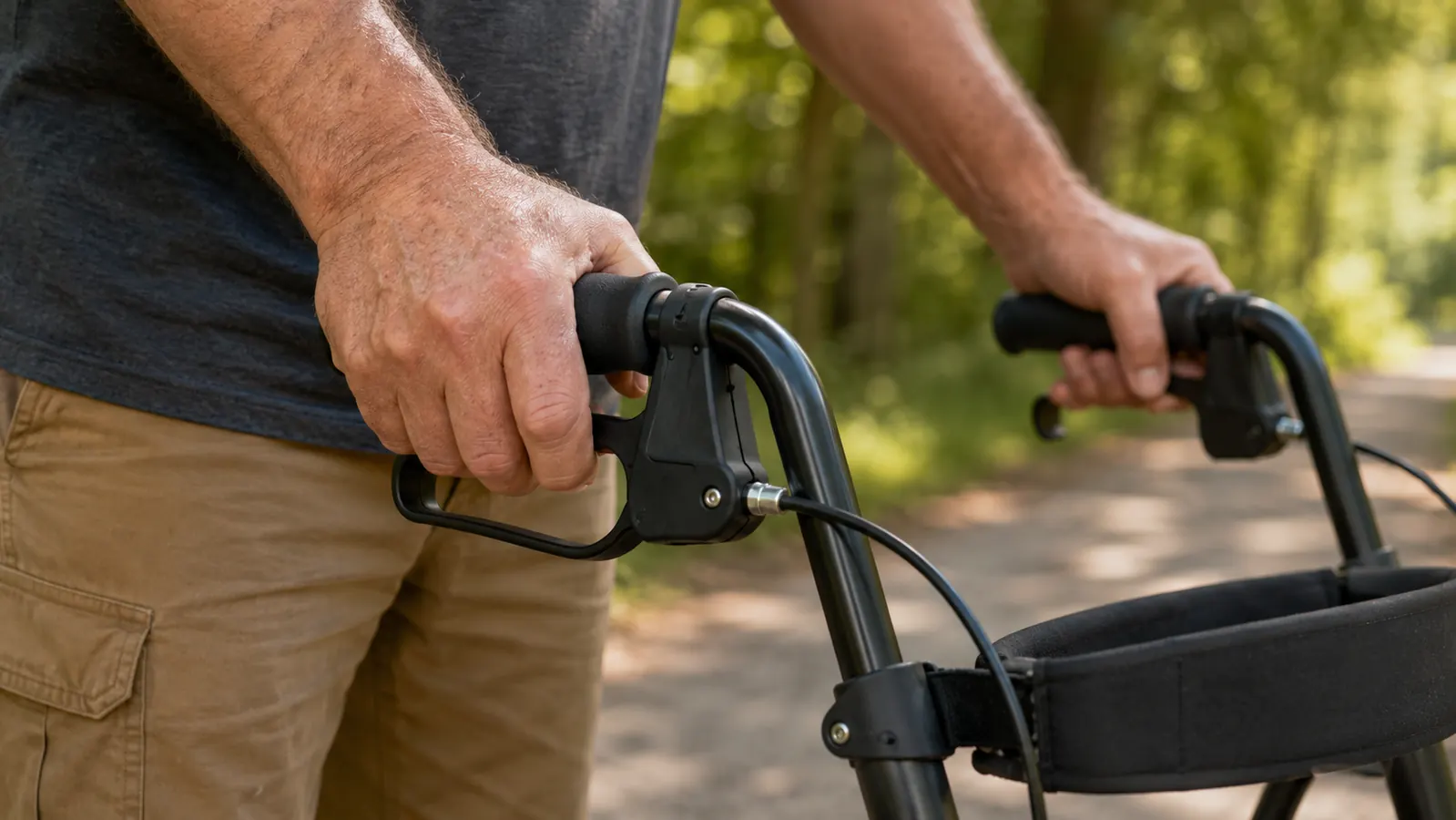
A rollator at the wrong height will make you hunch, and a hunched walk is hard on your back and your confidence. The rule I was given is simple: stand with your arms relaxed at your sides, and the handles should sit right around your wrist. The Drive Medical rollator has handles you can adjust on the legs of the frame, and I check mine before every walk. It is the same kind of quick check I do on the car mirrors before I pull out. It takes about thirty seconds.
Then practice the brakes. You squeeze the handles to slow down, and you push down to lock them. I practiced on the sloped walk by my front door until locking was pure muscle memory. Locked brakes are what make sitting on the seat safe. You sit down after you lock, never before. That order matters, and after a fall or two, you will never forget it. Your balance thanks you when you take the extra second.
Here is the drill I would give anyone starting out. Walk a few steps with the rollator, squeeze gently to feel the drag, release, walk a few more, lock, sit, stand, unlock. Ten minutes of that at home saves you from working it out on a downhill with a car coming. Practice is not for people who are weak. Practice is for people who want to stay active.
Step 3: Pack Light and Keep Both Hands on the Handles
The basket under the seat will hold a lot, which is exactly the temptation. I carry a water bottle, my phone, my house key, and a small packet of tissues, and nothing else. A heavy basket makes the front end wander and turns steering into a chore. Light is not just easier; it is safer, because it keeps the rollator moving the way you expect it to.
When you walk, keep both hands on the handles. The rollator is rolling support, not a grab bar. You let it take some of your weight, but you keep your own balance working. That is what my physical therapist drilled into me: this gear is here to help you stay active, not to be a wall you hang on. Your hands are your steering, your brakes, and your safety, all at once. I think about that every single walk.
When you need something out of the basket, stop, lock the brakes, reach down, and stand back up. Reaching while moving is how you end up off balance. Stop, sit, stand, go. That rhythm becomes the walk, and after a few weeks you will not even think about it.
Step 4: Use the Curb Cuts and Take Slopes With a Plan
Outdoor walking is mostly not about distance. It is about curbs, slopes, gravel, and the occasional patch of wet leaves. My rule now is to hunt the curb cut. The ramp at the corner is not the lazy route; it is the smart route, and I will cross the street to use one rather than fight a six-inch curb. The rollator rolls up a ramp as if it were level ground.
For slopes, take them at a slight angle and squeeze both brakes gently to control your speed on the way down. Going up, lean forward a little and let the wheels do the work. The 7.5-inch wheels on the Drive Medical rollator roll over sidewalk cracks and packed paths far better than the small wheels on a basic walker, but they are not off-road tires. If the path turns to soft mud or deep gravel, find the paved version instead. Slow and steady is not a consolation prize; it is the whole method.
And if a curb has no cut and no ramp anywhere nearby? Turn around and find another way. The whole point of this gear is that you get to choose the easy path and not feel one bit guilty about it. I spent a long time feeling guilty about taking the easy route. I am over it, and you should be over it too.
Step 5: Start Small and Sit on Purpose
My first outdoor rollator walk was fifteen minutes around the block. I locked the brakes at the halfway point, sat down on the seat, and watched a neighbor's garden for a bit. I did not really need the rest. I took it anyway, because the entire point of the seat is that you get to take it anyway. Sitting on purpose is the skill.
That is the change the seat makes. Without it, a walk has a point of no return. You have gone far enough that the way back is more than you want to manage, and you start watching your steps instead of enjoying them. With the seat, there is no such point. You can stop anywhere, sit for two minutes or ten, and continue when you are ready. You push yourself less and end up doing more, because you are not afraid of being stranded. The walk belongs to you, not to a stopwatch.
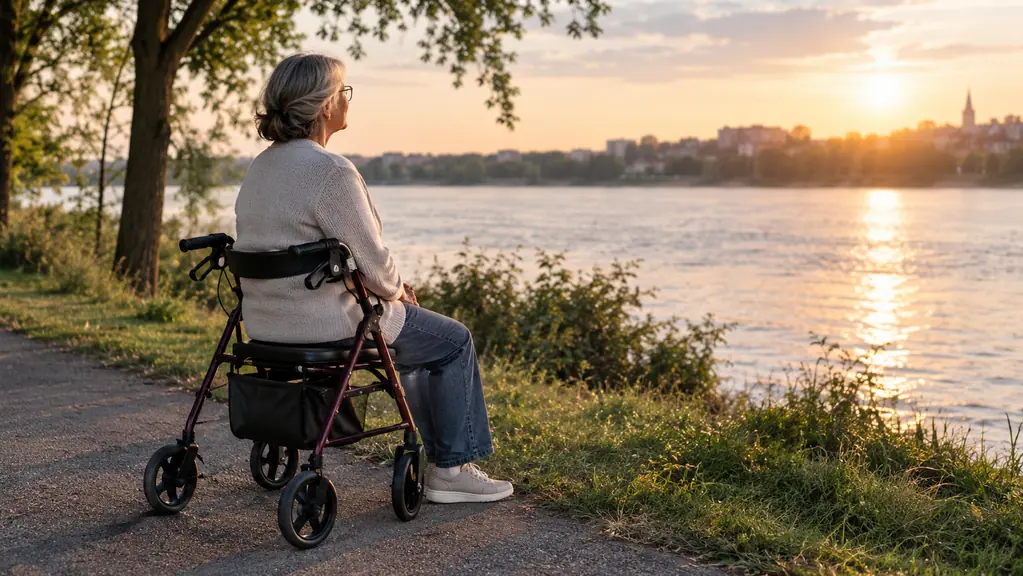
Within a month, the fifteen-minute loop had become thirty. By summer, I was back on the river path, sitting on my rollator seat at the boathouse turn and watching the rowers. The gear did not make me younger. It made me unafraid, and that was enough. The river path is still my favorite, and I walk it most mornings when the weather cooperates. That is what staying active outdoors is really about.
What Else Helps
A rollator is the centerpiece, but a few small things make the whole system work. Shoes with grippy soles matter more than any walker does, so I retired my old slick-soled sneakers. A fully charged phone and a house key that lives in the basket, not in my pocket, mean I can walk out the door without a checklist. Sunscreen and a water bottle I actually remember to drink from. And tell someone your route: my daughter Kate gets a text when I head out on the river path, and she knows roughly when I will be home. The goal is to make leaving the house the easy part, so the walk is the only thing you have to think about.
If you have had a fall recently, or you are working around a balance problem or a recovery from surgery, here is where I sound like the dental office manager I used to be. Talk to your doctor or a physical therapist before you start. They can watch you walk, set the height with you, and tell you whether a rollator is the right tool or whether something else fits your situation better. That visit is not a detour. It is part of the plan, and it is the smartest first step you can take. A few minutes with a professional is the cheapest insurance you will ever buy.
The seat is the whole trick outdoors. Knowing I can stop and sit anywhere turned a walk from a worry back into a pleasure.
Take the easy path, and take a seat with you
The Drive Medical Rollator Walker with Seat gives you a place to rest, a basket for the essentials, and 7.5-inch wheels that handle real sidewalks and packed paths. It has been part of my morning routine for over a year. If this sounds like the kind of help you are looking for, check today's price on Amazon and see for yourself.
Amazon Check Today's Price on Amazon →