
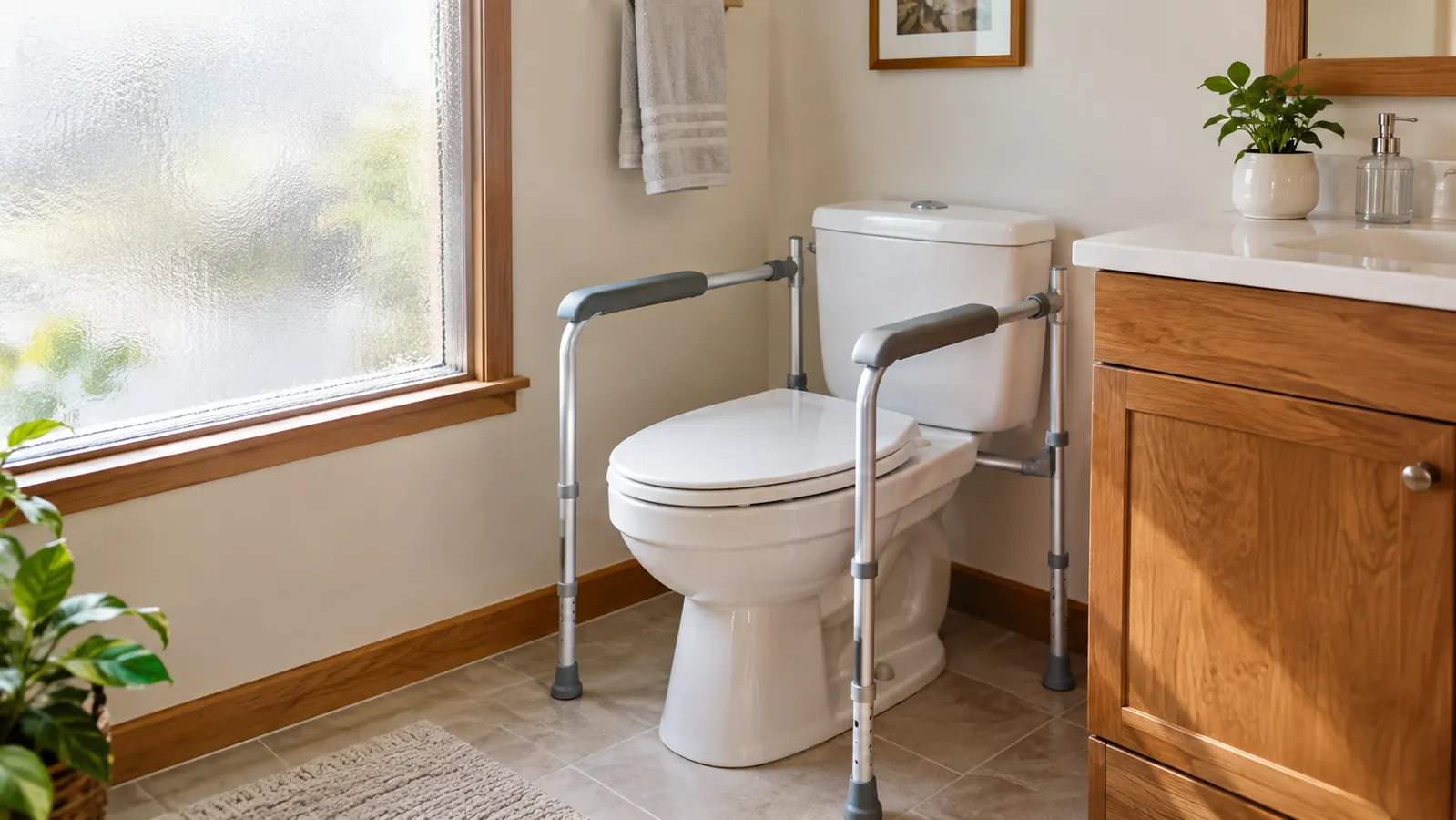
For most of my life I never gave a second thought to sitting down on a toilet or getting back up again. Then came the winter I slipped getting out of the tub and spent a few weeks with a bruised hip, and suddenly the lowest seat in my house turned into the hardest part of my day. That is how the Vive Toilet Safety Rail ended up in my upstairs bathroom. I have now used it every single day for months, several times a day, and I have opinions.
I am Marjorie, I am 67, and I live alone in a 1962 split-level outside Hartford. Nobody is down the hall to give me a hand if I get stuck halfway up. So when I review something like the Vive rail, I am not asking whether it looks nice in a catalog photo. I am asking whether it holds steady at six in the morning when my knees are stiff and the light is still gray, and whether I would trust it the same way a year from now.
The Quick Verdict
A sturdy, adjustable frame that turns sitting down and standing up into a controlled, two-handed movement. It took some fiddling to fit my toilet, and the padded arms show wear, but it has made my bathroom a place I no longer dread.
Amazon Check Today's Price →See the rail I use every morning
The Vive Toilet Safety Rail is the adjustable frame that lives around my upstairs toilet. Check the current price, the size options and the latest reviews before you decide.
Amazon Check Today's Price on Amazon →How I've Used It
The rail lives around the toilet in my upstairs full bathroom, which is the one I use first thing in the morning and last thing at night. The downstairs half bath is fine for a quick visit during the day, but upstairs is where I needed the help, because that is where I am stiffest and the most tired.
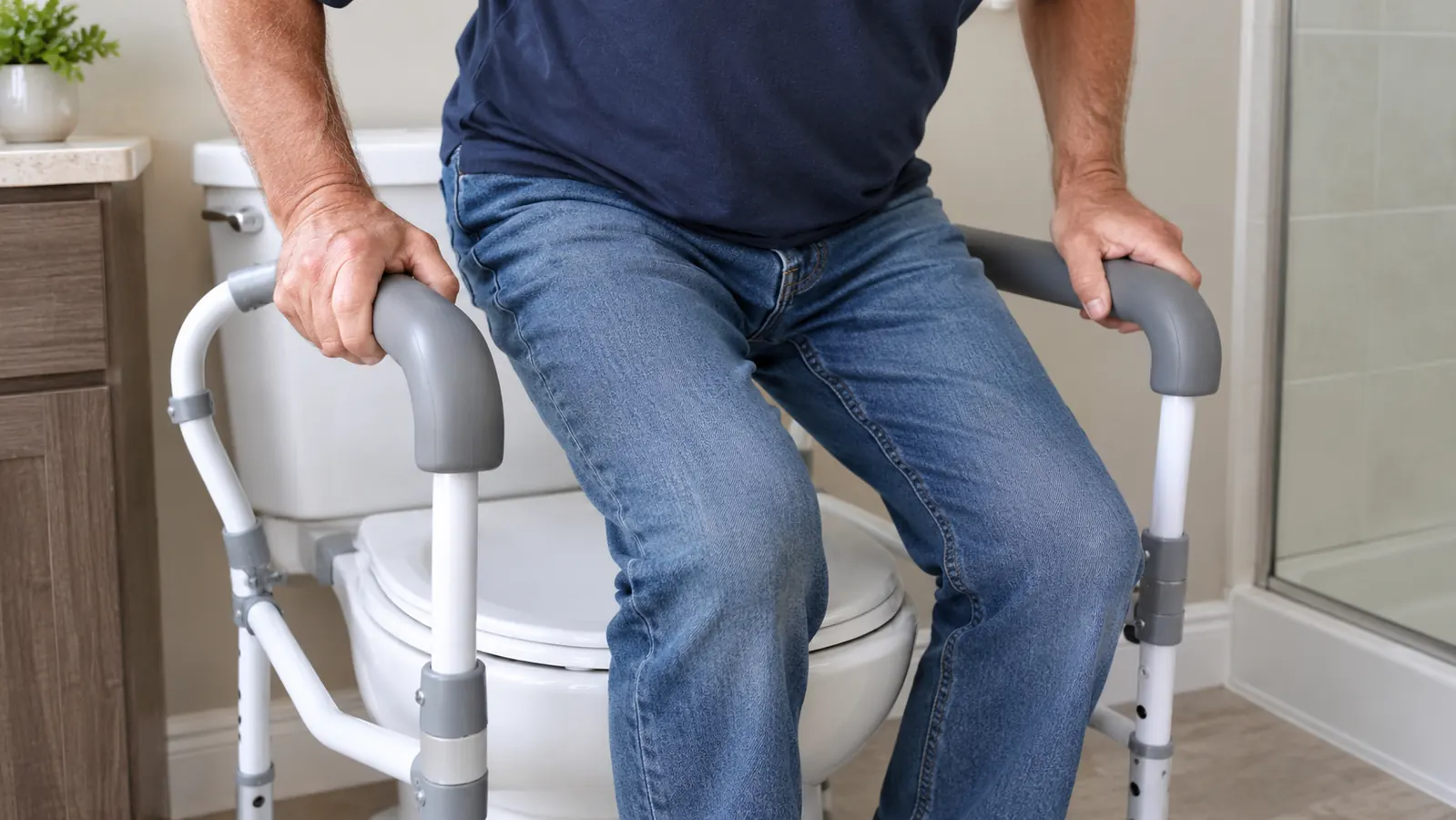
A typical day looks like this. I get up, walk the short run of stairs with one hand on the banister, and use the bathroom before anything else. I lower myself with both hands on the padded arms of the Vive rail, so the seat comes to meet me instead of me dropping onto it. When I stand, I shift forward, put my weight through my feet and push up with both arms at the same time. It is a small thing, but it changes the whole movement from a wobbly lunge into something deliberate.
I use it again after my morning walk, again in the afternoon, and before bed. By my count that is somewhere between five and eight times a day, every day, for months. That adds up to well over a thousand times I have pushed myself up off that frame. I mention the number because a lot of reviews are written after a week, and a week tells you almost nothing about a piece of equipment you put your weight on.
My daughter Kate was the first to notice the difference. She visits most weekends, and before the rail went in she had started hovering outside the bathroom door, pretending she was not listening for me. Now she does not hover. She told me it was the first piece of safety gear in the house that she stopped worrying about once it was in place.
What Months of Daily Use Have Taught Me
The first lesson is that the fit matters more than anything else. The Vive frame adjusts in height and in width, and those adjustments are the reason it works for me. My toilet sits a little low, which is common in houses built when mine was. I set the arms high enough that my forearms sit level when my elbows are bent, roughly where my hands would land if I were pushing up from a dining chair. Getting that height right took two tries. The first setting was a notch too low and I found myself leaning forward to reach the arms, which defeats the purpose.
The second lesson is about steadiness. A rail like this works because it braces itself against the floor and around the base of the toilet, so it does not depend on any wall anchors. After assembly I tested it the way a physical therapist once showed my mother: hands on both arms, a firm push down, then a gentle side to side rock. On the first day it had a slight shimmy, and that turned out to be one leg sitting on a grout line. I nudged it half an inch and the shimmy disappeared. Since then it has not moved.
The third lesson is about the padded arms. They are comfortable, especially on cold mornings when bare metal would be unpleasant, and they give a bit of grip. After a few months the padding on the right arm, the side I lean on harder, has started to show a faint dent where my palm lands. It has not torn and it has not slipped, but it is the first sign of wear, and it is worth knowing that the part you touch most will age first.
The fourth lesson surprised me. I expected the rail to help me get up, and it does. What I did not expect is how much it helps me sit down. Going down is the moment when a lot of us lose control, because the last few inches turn into a drop. With both hands on the arms I can lower myself slowly the whole way. My knees thank me for it every morning.
Finally, cleaning. A bathroom frame has to be cleaned like everything else in the bathroom, and I was worried about that. In practice I wipe the arms and the frame with the same spray I use on the sink once a week, and I give the feet a quick look while I am down there. It takes two minutes. The finish has not rusted or flaked, even in a bathroom that gets steamy every morning from the shower next to it.
The Details That Matter When You Live Alone
Living alone changes how you judge equipment. If something fails, there is no one to catch you and no one to call out to. So I care about a few details that might not matter as much in a busy household.
I care that the Vive rail is wide enough for me to use without twisting. Some frames are so narrow that you have to turn sideways to get between the arms, which is exactly the kind of awkward move that leads to a stumble. Once I set the width, I could walk straight in, turn, and sit, with an arm under each hand. I also care that it leaves the toilet itself alone. Nothing bolts to the seat or the bowl, so there is nothing to work loose over time and nothing to get in the way of cleaning.
I care about the feet. The rubber tips on the legs are what keep the frame from skating across a wet floor. I check them about once a month by running a finger around each one, looking for cracks or flattening. So far they look the way they did on day one. If they ever wear, replacement tips are the kind of small part I would rather swap early than late.
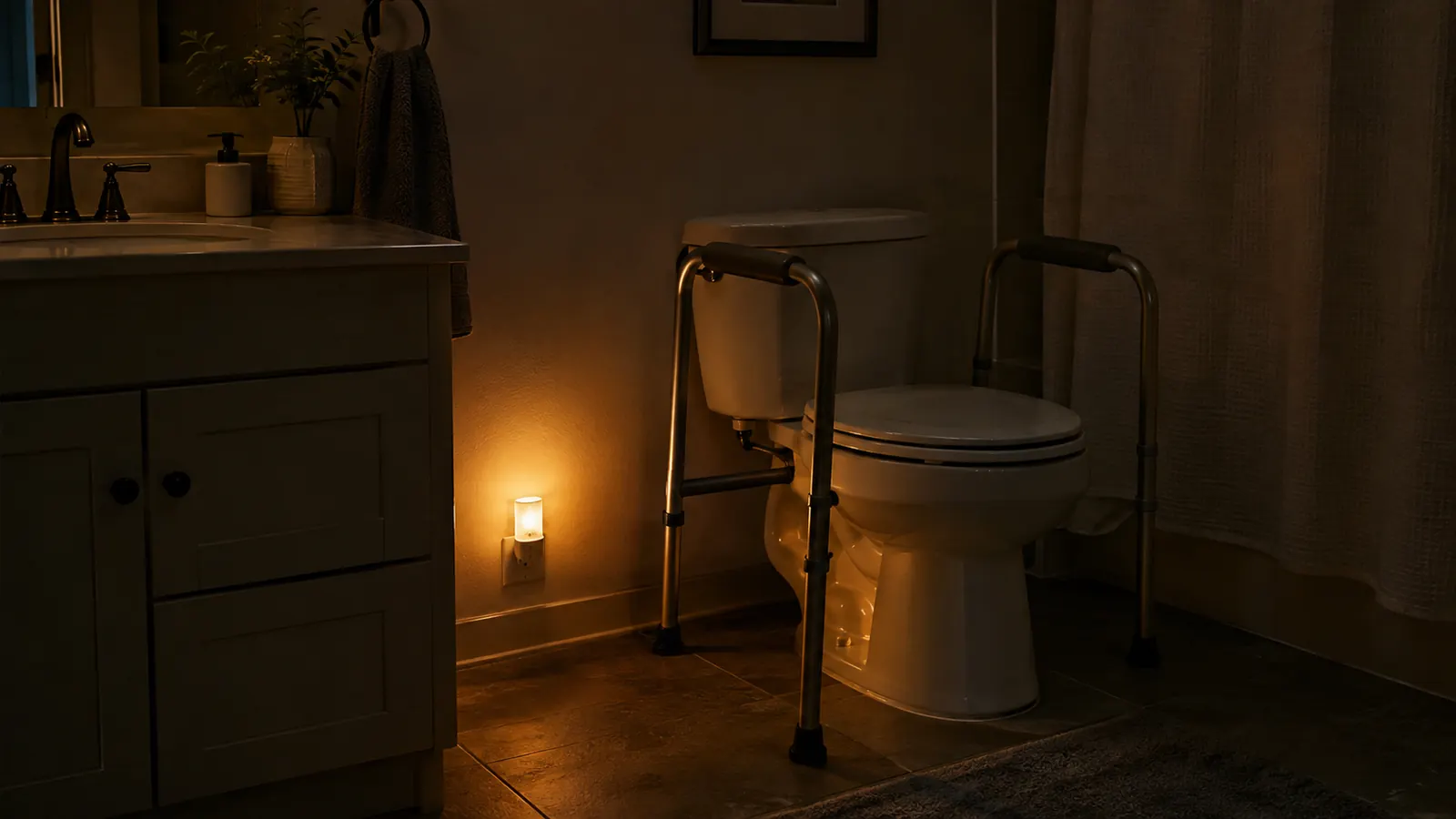
And I care about the nighttime. My bathroom has a small motion-sensor night light near the floor, so when I come in at two in the morning I can see the outline of the frame without turning on the overhead light and waking myself all the way up. The two together have made the middle of the night far less of an adventure. If you are setting up a bathroom for yourself or a parent, I would put a little light down low before anything else.
Where the Vive Rail Comes Up Short
No product is perfect, and I would not trust a review that pretended otherwise. My first complaint is assembly. The instructions are clear enough, but lining up the push buttons on the height adjustment takes patience and decent eyesight. I did it sitting on the bathroom floor with my reading glasses on and the overhead light at full brightness, and it still took me about twenty minutes. If your hands are arthritic or your vision is poor, ask a family member to help with the first setup.
My second complaint is that the frame takes up real space. In a small bathroom like mine it narrows the gap between the toilet and the vanity, and I had to move a small trash can and a magazine basket to keep the path clear. That is a fair trade for me, but if your bathroom is very tight, measure first and picture yourself walking in with the frame in place.
Third, it is not a lift. It gives you something solid to push against, but your own legs and arms still do the work. If you cannot stand up from a seat at all, or you are recovering from hip or knee surgery, this frame is not a substitute for what your doctor, physical therapist or occupational therapist recommends. Ask them first. They may suggest a raised seat, a different kind of support, or both.
Last, check the weight rating against your own weight before you buy, and do not lean on it in ways it was not designed for, like using it to pull yourself up from the floor. It is built to steady you on the way down and the way up from the seat, and that is how I use it.
The Alternatives I Considered
Before choosing the Vive rail I looked at three other approaches. The first was a pair of wall-mounted grab bars beside the toilet. Bars screwed into the studs are excellent, but my toilet sits next to the tub on one side and a vanity on the other, so there was no good wall to anchor them to without opening up tile. The second was a raised toilet seat with built-in handles. Those work well for some people, but I did not love the idea of a seat that has to come off every time I clean, and I wanted something that would work at both heights if my needs change.
The third option was a heavier freestanding toilet safety frame that sits over the toilet entirely. It looked solid but bulky, and in my small bathroom it would have felt like a piece of hospital furniture. The Vive rail struck the balance I wanted: it is sturdy where it counts, it adjusts to my toilet, and it looks like part of a home bathroom rather than a care facility. If you are weighing it against another popular frame, the side by side comparison on this site walks through the differences.
What I Liked
- Height and width adjust, so it fits a low older toilet and lines up with your forearms
- Braces against the floor around the toilet, with no drilling and nothing bolted to the bowl
- Padded arms are comfortable on cold mornings and give a secure grip
- Helps you sit down slowly, not just stand up, which protects stiff knees
- Easy to wipe clean weekly, and the finish has held up in a steamy bathroom
Where It Falls Short
- Assembly and the push-button height pins take patience and good eyesight
- Takes up real floor space in a small bathroom
- Padding on the arm you lean on most shows wear after a few months
- It steadies you but does not lift you, so it is not a fit for everyone
Going down is the moment when a lot of us lose control. With both hands on the arms, I can lower myself slowly the whole way.
Who This Is For
The Vive Toilet Safety Rail is a good fit if you can still stand up on your own but find it harder than it used to be, if your toilet sits on the low side, or if you live alone and want something solid under your hands at the two moments when most bathroom stumbles happen. It is also a smart choice for an adult child setting up a parent's bathroom, because it needs no drilling and can be adjusted as their needs change. In my house it has quietly become one of the most used pieces of safety gear I own.
Who Should Skip It
Skip it if your bathroom is so small that the frame would block your path, or if you already have well-placed grab bars anchored into the studs and they serve you well. Skip it, or at least ask your care team first, if you need someone to physically help you stand, if you are recovering from surgery, or if your weight is close to the frame's limit.
If you are unsure, start with a short conversation with your doctor or an occupational therapist. They can look at your bathroom, watch you sit and stand, and tell you whether a frame like the Vive rail is the right tool or whether something else would serve you better. For me, after months of daily use, it was the right call.
Make the hardest seat in the house an easy one
If getting up from the toilet has started to feel like a project, the Vive Toilet Safety Rail is the frame I trust every morning. See the price and sizing on Amazon.
Amazon Check Today's Price on Amazon →